Why Calculus Matters More Than You Think
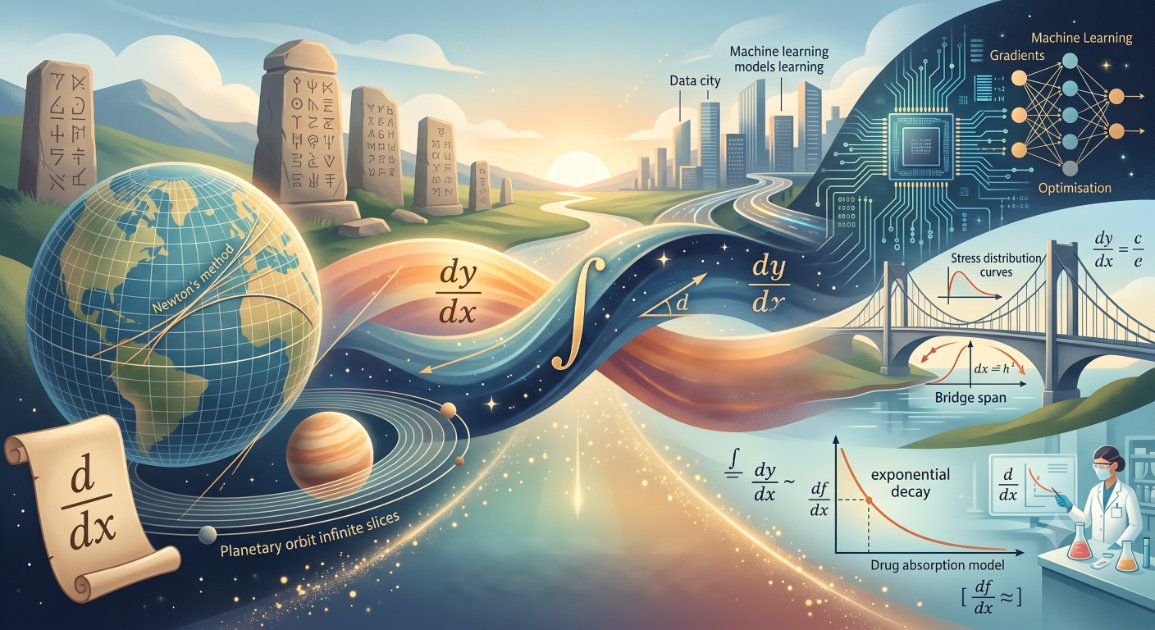
Most people think calculus is just a painful school subject you forget immediately after the exam. In reality, it's the mathematical language that describes how everything in the universe changes — and its ideas are everywhere once you know how to look.

Why Calculus Matters More Than You Think
Most people remember calculus as something like this: a teacher writing cryptic symbols on a whiteboard, a painful exam, and then a relief when it's over. Something you did once and never used again.
This view is almost entirely wrong.
Calculus is not a set of techniques to memorise. It's a way of thinking about change — and change is everywhere. Here's why calculus is one of the most powerful ideas human beings have ever developed.
What Calculus Actually Is
Calculus is the mathematics of change and accumulation. It has two fundamental operations:
Differentiation answers: How fast is something changing right now?
Integration answers: How much has accumulated over time?
These two operations are inverses of each other — one of the most beautiful facts in mathematics (called the Fundamental Theorem of Calculus).
That's it. All of calculus — every technique, every application — is an extension of these two ideas.
The Problem That Invented Calculus
In the 17th century, Newton wanted to understand planetary motion. The problem: a planet's speed is constantly changing as it moves in its elliptical orbit. The mathematics of the time could only handle constant speeds. There was no way to calculate instantaneous speed — speed at a single moment.
Newton's insight: approximate the curve of position vs. time with tiny straight lines. As those lines get shorter and shorter (infinitely small), the approximation becomes exact. This is the definition of a derivative — the limit of a ratio as the interval shrinks to zero.
Newton called it "the method of fluxions". Leibniz independently discovered the same idea and gave us the notation we use today (dy/dx). They argued about credit for decades. The world got calculus from both.
Where Calculus Lives in the Real World
Once you know what calculus is, you start seeing it everywhere.
Physics: Newton's laws of motion are differential equations. F = ma is actually F = m(d²x/dt²) — force equals mass times the second derivative of position. Every equation of classical mechanics is a statement about rates of change.
Engineering: The stress in a bridge beam, the flow of current through a circuit, the heat distribution in a material — all described by differential equations derived from calculus.
Economics: Marginal cost and marginal revenue (the cost/revenue of producing one more unit) are derivatives. Optimisation — finding the minimum cost or maximum profit — is calculus.
Machine learning: Training a neural network means minimising a loss function. The algorithm used (gradient descent) moves in the direction of the negative gradient — the derivative of the loss with respect to every parameter. Every time a model learns something, calculus is happening thousands of times per second.
Medicine: Pharmacokinetics — how drugs are absorbed, distributed, and eliminated — is modelled by differential equations. The decay curve of a drug in your bloodstream is exponential, described by calculus.
The Two Key Intuitions
The Derivative: Zoom In Enough and Every Curve Becomes Straight
If you zoom into any smooth curve at a single point — keep zooming — eventually it looks like a straight line. The slope of that line is the derivative.
This is remarkable: a tool for understanding curved, changing things, built entirely from straight lines and limits. The power of abstraction.
The Integral: Infinity of Thin Slices Add Up to Something Exact
Integration is the opposite operation — but its intuition is equally beautiful. Want the area under a curve? Divide it into infinitely many infinitely thin rectangles. Each has area = height × width. Add them all up. As the width → 0, the sum → an exact area.
This idea — summing infinitely many infinitely small pieces to get a finite answer — is one of the most profound in all of mathematics.
Calculus and Intuition
The greatest physicists and engineers don't crunch derivatives symbol-by-symbol. They feel what a function is doing — they see a steep curve and think "high derivative", a flat region and think "local minimum", a rapidly growing area and think "large integral".
This intuition is what calculus gives you after the techniques are internalised: a way to look at a changing system and understand it without calculating, the way a musician hears a chord and knows its structure without counting intervals.
You Don't Need to Be a Mathematician
You don't need to solve differential equations to benefit from understanding calculus. What you need is the conceptual framework:
- Rates of change are derivatives. When someone says "the rate of inflation is slowing down", that's a statement about the second derivative of prices.
- Accumulation is integration. When you track total CO₂ emissions over 50 years, you're integrating a rate over time.
- Optimisation is finding where the derivative equals zero. Every algorithm that finds a "best" answer is doing calculus in some form.
These ideas appear in every quantitative field. Understanding them makes you more capable of reasoning about the world — not just in mathematics, but in economics, engineering, biology, technology, and beyond.
The Bigger Point
Calculus was invented to describe the physical universe, and it worked almost unreasonably well. The same mathematics that describes a falling apple describes the orbit of a planet and the curvature of spacetime. This is not a coincidence — it's a hint that calculus has discovered something deep about the structure of reality.
That's why calculus matters. Not the techniques. The ideas behind them.
When you understand calculus, you gain access to a language that nature itself seems to be written in. That's worth more than any exam grade.
Comments
No comments yet. Be the first to share your thoughts.
Leave a comment
Learn this live, with Prasant
Articles give you a foundation. Live classes give you mastery — where you can ask questions, get real feedback, and build projects.
Browse Courses →