Building Physics Intuition: How to Think Like a Physicist
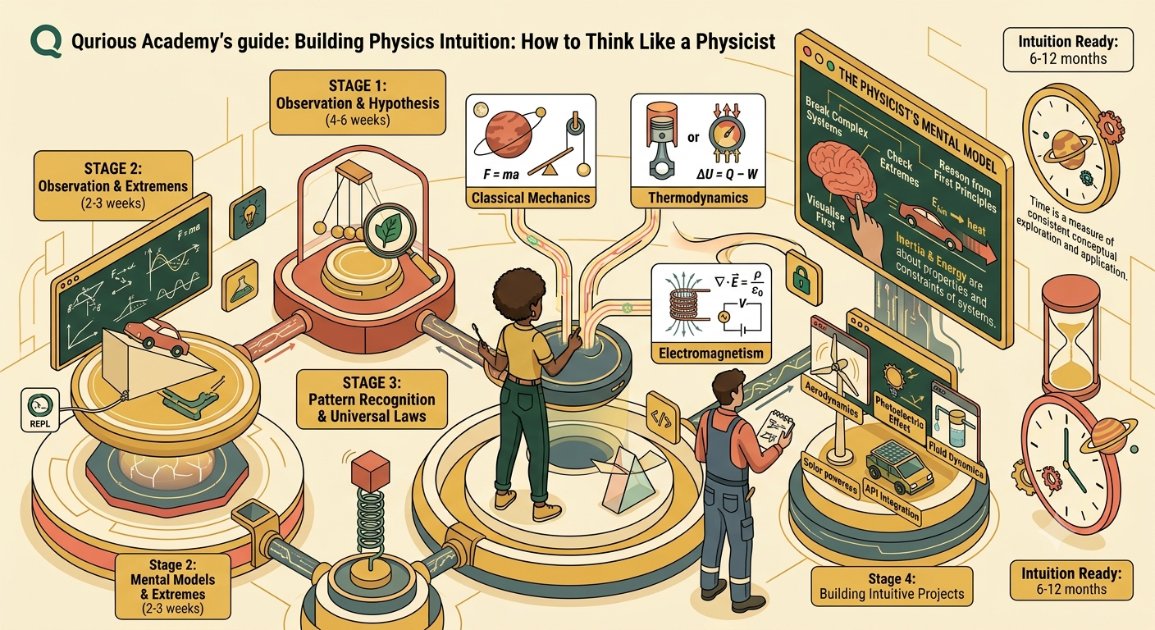
Memorising formulas won't make you good at physics. Building intuition will. Here's how to develop a genuine feel for the physical world — and why it changes how you see everything.

Building Physics Intuition: How to Think Like a Physicist
Most students learn physics by memorising formulas and plugging in numbers. They can solve textbook problems but feel completely lost when asked, "What's actually happening here?"
That gap — between formula-fluency and genuine understanding — is what we call intuition. And it's the difference between a student who passes physics and an engineer who designs real things.
Here's how to build it.
Why Formulas Are Not Physics
A formula is a compressed summary of a physical insight. F = ma doesn't define physics — it captures a relationship that took centuries of observation, argument, and experimentation to establish.
When you memorise F = ma without understanding it, you have a tool you don't know how to use. You can only apply it in situations that look exactly like the examples you've seen.
Intuition means understanding why F = ma is true, what it predicts, where it breaks down, and what it feels like in the real world. With that, you can apply it in situations you've never seen before.
Start With Extreme Cases
The single most powerful technique in a physicist's toolkit: check the extremes.
Take any formula or concept and ask: what happens when this variable is very large? Very small? Zero? Infinite?
For example — gravitational force between two objects: F = Gm₁m₂/r²
- What happens as r → ∞? Force → 0. Objects infinitely far apart don't affect each other. ✓
- What happens as r → 0? Force → ∞. Objects can't occupy the same space. (This tells you the formula breaks down — which leads to interesting physics.)
- What if one mass is zero? Force = 0. You can't pull on something that doesn't exist. ✓
Each of these checks either confirms the formula makes sense or reveals something worth thinking about. This habit — checking extremes — is how physicists catch errors and build understanding simultaneously.
Dimensional Analysis: Physics' Built-in Error Checker
Every physical quantity has dimensions — combinations of mass (M), length (L), and time (T).
- Speed: L/T (metres per second)
- Force: ML/T² (kilogram-metres per second squared, i.e., Newtons)
- Energy: ML²/T²
If you're ever unsure whether a formula is right, check that the dimensions on both sides match. If they don't, something is wrong. No exceptions.
This is so powerful that physicists often derive approximate formulas purely from dimensional analysis — without solving any equations at all.
Build Mental Models From Everyday Life
Physics intuition comes from connecting abstract concepts to things you've already experienced.
Inertia: You feel it every time a car accelerates and you're pushed back in your seat. The more massive the car, the more you feel it. That's F = ma.
Conservation of energy: A pendulum swings back to the same height it was released from (ignoring air resistance). All the potential energy at the top converts to kinetic energy at the bottom and back — no energy appears or disappears.
Pressure: Why does a nail go into wood easier than a flat board? Same force, smaller area = more pressure. P = F/A isn't just a formula, it's why knives are sharp.
Every time you see something physical happen in your day — a car stopping, a ball bouncing, water flowing — ask: what's the physics here? That habit, sustained over months, builds the strongest kind of intuition.
The Estimation Habit (Fermi Problems)
Physicists love estimation. Not because precision doesn't matter, but because a good estimate tells you whether you're in the right ballpark before you do any detailed calculation.
Enrico Fermi was famous for this. Classic Fermi problems:
- How many piano tuners are in Chicago?
- How many golf balls fit in this room?
- How high would a stack of a million dollars in $100 bills reach?
These problems train you to break complex questions into simpler estimates, reason from what you know, and get comfortable with approximation. In real physics and engineering, this skill is more valuable than many precise calculations.
Visualise Before You Calculate
Before writing any equation, draw a diagram. Mark forces, directions, and reference frames. Physicists rarely start with equations — they start with pictures.
This isn't just a study technique. Visualisation is how physicists think. Einstein famously said he thought in images and feelings, and only later translated those insights into mathematics.
The diagram makes the physics visible. The equation just quantifies what the picture already showed you.
The Payoff
Physics intuition isn't just useful for physics problems. It trains a way of thinking:
- Break complex systems into components
- Check your answers at the extremes
- Reason from first principles when you don't have a formula
- Estimate before you calculate
These habits transfer everywhere — engineering, programming, medicine, economics. Physics is one of the best trainers of rigorous thinking precisely because nature doesn't let you get away with sloppy reasoning.
The goal isn't to memorise more formulas. It's to understand the world well enough that the formulas feel obvious once you see them.
Comments
No comments yet. Be the first to share your thoughts.
Leave a comment
Learn this live, with Prasant
Articles give you a foundation. Live classes give you mastery — where you can ask questions, get real feedback, and build projects.
Browse Courses →