How to Learn Python in 2026 (The Right Way)
Python is the most beginner-friendly programming language in the world. Here's a clear, opinionated roadmap for learning it effectively — without wasting months on the wrong things.
How to Learn Python in 2026 (The Right Way)
Python has been the world's most popular programming language for several years running. It's used in web development, data science, machine learning, automation, scripting, and more. If you're going to learn one language — Python is the right bet.
But popularity also means there's a flood of bad advice about how to learn it. Here's the opinionated, no-nonsense guide.
Why Python Is the Best First Language
- Readable syntax. Python reads almost like English. You spend less time fighting the language and more time thinking about the problem.
- No boilerplate. A Python "Hello World" is one line:
print("Hello, World!"). Compare that to Java's 7-line class structure. - Massive ecosystem. Whatever you want to build, there's a Python library for it.
- Industry demand. Python developers are hired across software engineering, data science, DevOps, and research.
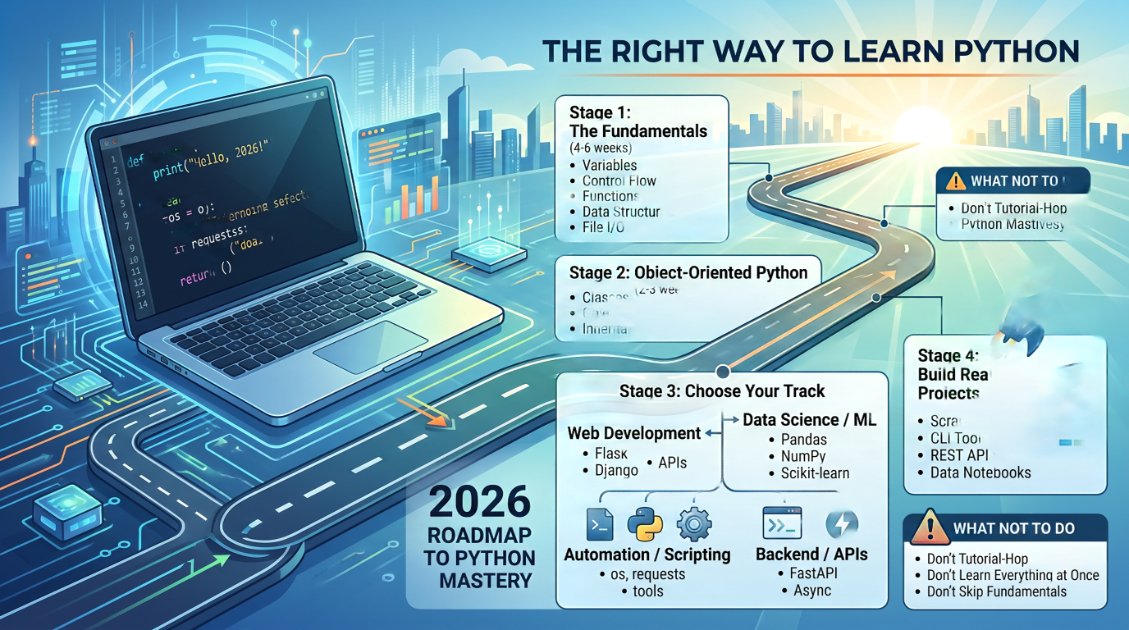
What NOT to Do
Before the roadmap, avoid these common mistakes:
Don't tutorial-hop. Watching 40 hours of YouTube videos without writing code teaches you nothing. Reading about swimming doesn't make you a swimmer.
Don't try to learn everything at once. Python has dozens of frameworks and libraries. You don't need to know them all. Pick a direction and go deep.
Don't skip the fundamentals. Jumping to Django or pandas without understanding functions, loops, and data structures creates fragile knowledge that collapses under pressure.
The Roadmap
Stage 1: The Fundamentals (4–6 weeks)
Learn these, in order:
- Variables and data types — strings, integers, floats, booleans
- Control flow — if/elif/else, for loops, while loops
- Functions — defining, calling, parameters, return values
- Lists, tuples, dictionaries, sets — Python's core data structures
- File I/O — reading and writing files
- Error handling — try/except
- Modules and imports — using Python's standard library
At this stage, write code every day. Small exercises beat big projects. A good resource: Automate the Boring Stuff with Python (free online).
Stage 2: Object-Oriented Python (2–3 weeks)
Learn classes, objects, inheritance, and dunder methods. You don't need to master every OOP concept — just understand enough to read and write class-based code, because most Python libraries use it.
Stage 3: Pick Your Direction
Python is too broad to learn "generally" beyond a point. After Stage 2, choose your track:
Web Development
- Learn Flask first (simpler), then Django (more complete)
- Understand HTTP, REST APIs, and databases (SQLite/Postgres)
Data Science / ML
- NumPy → pandas → matplotlib → scikit-learn
- Work through a real dataset, not toy examples
Automation / Scripting
- Learn
os,pathlib,subprocess,requests - Build tools that solve your own problems
Backend / APIs
- FastAPI is the modern choice — fast, async, with automatic docs
Stage 4: Build Real Projects
This is where learning becomes skill. Build things you actually want to use.
Ideas that work well for a portfolio:
- A web scraper that extracts data from a site you care about
- A CLI tool that automates something you do repeatedly
- A REST API with authentication and a database
- A data analysis notebook on a real dataset (Kaggle is a good source)
Projects force you to solve problems you didn't anticipate. That's where real learning happens.
The Python Mental Model
One thing that confuses beginners: Python passes objects by reference, not by value — with a twist. Mutable objects (lists, dicts) can be modified inside functions. Immutable objects (strings, integers) cannot. Understanding this early saves hours of debugging later.
Also learn to love the REPL. The interactive Python shell is one of the language's greatest strengths — use it to experiment, test ideas, and understand behaviour before writing a script.
How Long Will It Take?
Honest answer:
- Basic scripts you're proud of: 2–3 months of consistent practice
- Employment-ready: 6–12 months, including projects and DSA practice
- Genuinely good: 2–3 years of building real things
The ceiling is high. But the floor is also very accessible. Python is one of the few languages where you can build something genuinely useful within your first month.
Start today. The best time to begin was last year. The second best time is now.
Comments
No comments yet. Be the first to share your thoughts.
Leave a comment
Learn this live, with Prasant
Articles give you a foundation. Live classes give you mastery — where you can ask questions, get real feedback, and build projects.
Browse Courses →