Data Structures & Algorithms: A Beginner's Honest Guide
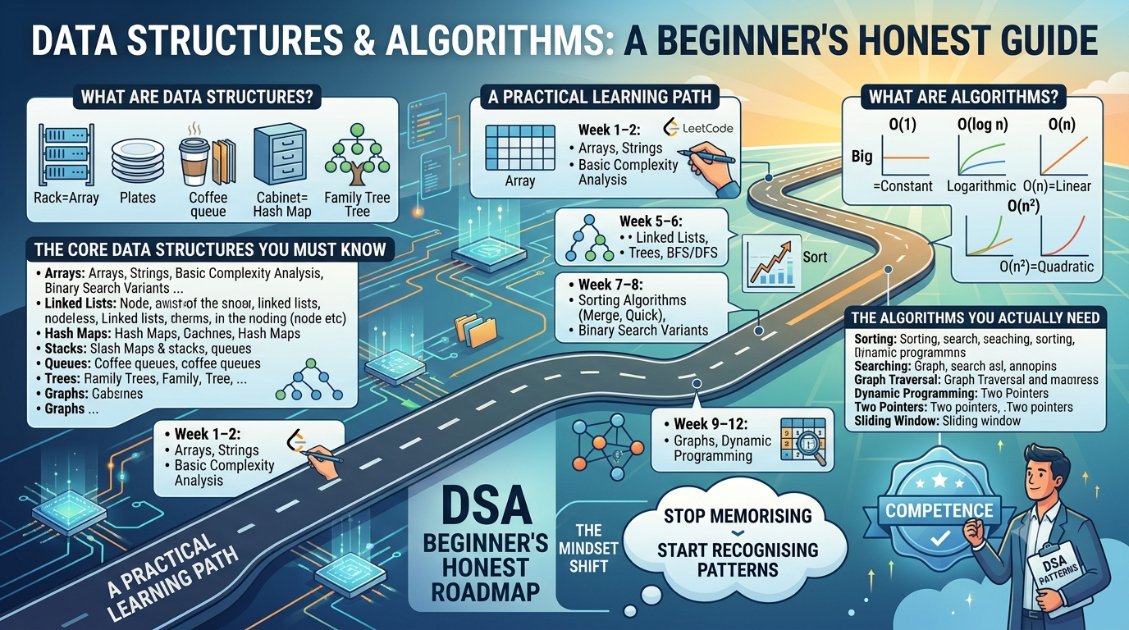
Every great programmer understands data structures and algorithms. Here's how to start — without the overwhelm, without the gatekeeping.

Data Structures & Algorithms: A Beginner's Honest Guide
If you've tried to learn DSA and felt like you were drowning — you're not alone. Most resources either over-simplify or throw you into a deep-end of theory. This guide is neither.
Here's what DSA actually is, why it matters, and how to build real competence.
Why DSA Feels Hard (And Why That's Normal)
DSA is essentially mathematics applied to programming. You're not just writing code — you're reasoning about how efficient your code is. That's a different skill than most beginners have developed.
The good news: it's learnable. The bad news: it takes time and deliberate practice. Anyone telling you otherwise is selling something.
What Are Data Structures?
A data structure is a way of organising data so it can be used efficiently.
Think of it like storage systems in a kitchen:
- A rack (array) — fixed slots, you know exactly where everything is
- A stack of plates (stack) — you only access the top
- A queue at a coffee shop (queue) — first in, first out
- A filing cabinet (hash map) — find anything instantly by its label
- A family tree (tree) — hierarchical relationships
The data structure you choose determines how fast your program runs.
The Core Data Structures You Must Know
Arrays
The simplest structure — a list of elements in order. Fast to access by index (O(1)), slow to insert in the middle (O(n)).
Linked Lists
Each element points to the next. Fast to insert/delete (O(1) at known position), slow to access by index (O(n)). Great for understanding pointers.
Hash Maps
The workhorse of interviews. Store key-value pairs, with O(1) average access. Almost every "optimise this" problem uses a hash map.
Stacks and Queues
Stack = LIFO (last in, first out). Queue = FIFO (first in, first out). Appear everywhere — undo operations, browser history, scheduling.
Trees and Graphs
Trees model hierarchical data (file systems, DOM, organisation charts). Graphs model relationships (social networks, maps, dependencies). Binary Search Trees, Heaps, and Tries are key variants.
What Are Algorithms?
If data structures are how you store things, algorithms are how you process them.
The most important concept to understand is Big O notation — a way of describing how your algorithm's speed scales with input size.
- O(1) — constant time. Doesn't matter how big the input is. Hash map lookup.
- O(log n) — logarithmic. Input doubles, work increases by 1 step. Binary search.
- O(n) — linear. Work grows proportionally with input. Loop through an array.
- O(n²) — quadratic. Nested loops. Gets slow fast.
The Algorithms You Actually Need
Sorting: Know how merge sort and quick sort work and why they're O(n log n). Understand when to use each.
Searching: Binary search is essential. Understand why it requires a sorted structure.
Graph traversal: BFS (breadth-first search) and DFS (depth-first search). These unlock trees, graphs, and most "find a path" problems.
Dynamic Programming: The hardest category. Start with recursion + memoisation before tackling bottom-up DP.
Two pointers and sliding window: Pattern-based techniques that solve many array/string problems in O(n).
A Practical Learning Path
- Week 1–2: Arrays, strings, and basic complexity analysis. Solve 20–30 easy problems on LeetCode.
- Week 3–4: Hash maps, stacks, queues. Pattern: "how would a hash map speed this up?"
- Week 5–6: Linked lists, trees, BFS/DFS.
- Week 7–8: Sorting algorithms from scratch. Binary search variants.
- Week 9–12: Graphs and dynamic programming. These need sustained practice.
Consistency beats intensity. 45 minutes daily beats 8-hour weekend marathons.
The Mindset Shift That Changes Everything
Stop trying to memorise solutions. Start trying to recognise patterns.
Most DSA problems are one of about 14 core patterns dressed in different clothes. Once you've seen the pattern enough times, you'll spot it even in new problems. That's the skill interviewers are testing — not your ability to memorise code.
DSA is hard, but it's a finite problem. Every concept in this guide can be understood with enough practice. Start with arrays. Stay consistent. The rest follows.
Comments
No comments yet. Be the first to share your thoughts.
Leave a comment
Learn this live, with Prasant
Articles give you a foundation. Live classes give you mastery — where you can ask questions, get real feedback, and build projects.
Browse Courses →