Breaking Free from Chunk ID Dependency: Why Most RAG Evaluation Is Broken
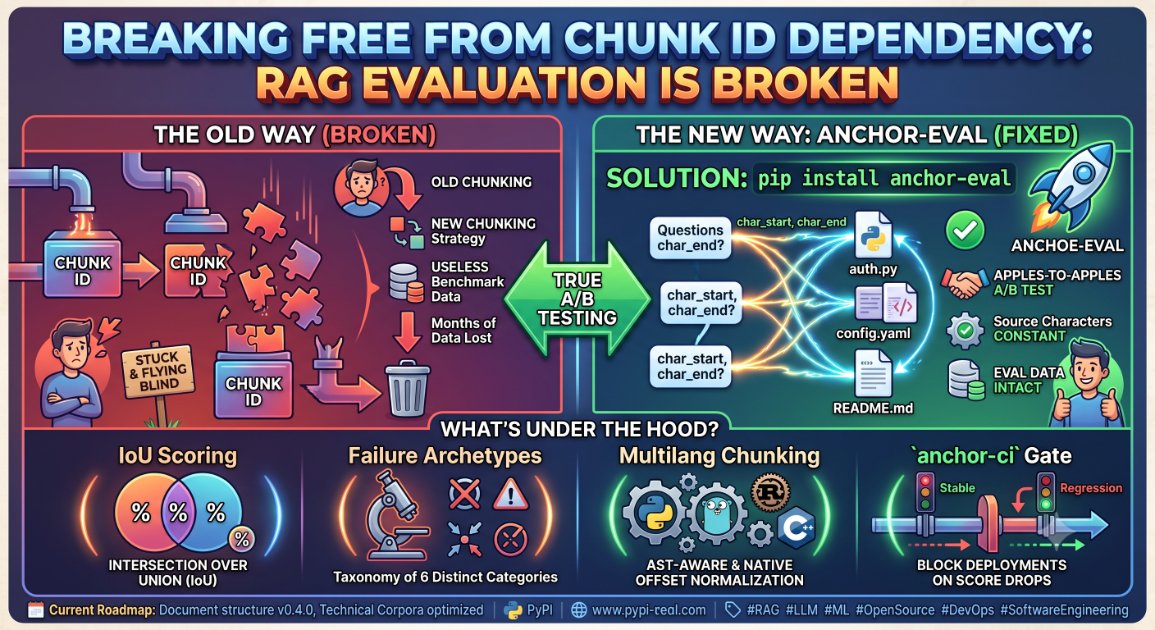
Most RAG benchmark datasets break the moment you change your chunking strategy. Learn why ephemeral Chunk IDs ruin evaluation data and how character-level anchoring enables true apples-to-apples A/B testing for your retrieval pipeline.

Breaking Free from Chunk ID Dependency: Why Most RAG Evaluation Is Broken (and How to Fix It)
Most RAG evaluation is fundamentally broken. And it’s because of a silent trap: Chunk ID dependency.
The Problem
We’ve all been there: You build a RAG pipeline and set up a solid benchmark dataset. The standard playbook? Take a text chunk, use an LLM to generate a question, and test if your retriever can pull that exact chunk ID back.
It works beautifully—until you want to optimize your pipeline.
The moment you switch your chunking strategy (say, moving from 512-token fixed windows to semantic chunking), your entire benchmark dataset becomes completely useless. The old chunk IDs no longer exist.
You are forced to choose between two bad options:
- Throw away months of hard-earned evaluation data and regenerate it.
- Never experiment with chunking configurations at all.
Because of this friction, most teams stay stuck with their first, sub-optimal chunking strategy. They are flying blind.
The Solution: anchor-eval
🎉 anchor-eval is now live on PyPI!
pip install anchor-eval
Instead of binding evaluation metrics to ephemeral chunk IDs, anchor-eval anchors benchmark questions directly to raw, character-level spans (char_start, char_end) within the source files.
{
  "question": "How does this codebase validate API keys?",
  "anchor": {
    "file": "auth.py",
    "char_start": 1820,
    "char_end": 2140
  }
}
Why this matters: Because source characters remain constant regardless of how you partition them, you can completely overhaul your chunker, swap your embedding model, or add a cross-encoder re-ranker—and your evaluation dataset remains perfectly intact. You finally get a true apples-to-apples A/B test.
What’s Under the Hood?
- Span Algebra & IoU Scoring: Evaluates retrieval performance using Intersection-over-Union (IoU) semantics on character spans rather than binary chunk hits.
- Failure Archetype Taxonomy: Classifies retrieval failures into 6 distinct categories (e.g., cross-file queries, negative space, lexical collisions) so you know why a pipeline broke, not just that it broke.
- AST-Aware Multilang Chunking: Ships with pre-configured, signed language packs for 8 languages (
Python,Go,Rust,Java,Kotlin,TypeScript,C,C++) handling per-language offset normalizations natively. anchor-ciGate: A native CI/CD gate with a strict 3-exit-code contract (Stable, Regression, Corpus Drift) to automatically block deployments if a PR triggers a score drop in a specific failure archetype.
Current Roadmap & Feedback
Right now, the framework is heavily optimized for technical corpora and source codebases. Document structure support is partially live and will be fully stabilized in v0.4.0.
If you are building advanced RAG architectures over complex text layouts, code, or documentation, I would love for you to take it for a spin and share your feedback!
- 📦 PyPI: anchor-eval on PyPI
Join the Conversation 👇
How is your team handling RAG regression testing when changing data ingestion pipelines? Let me know in the comments!
#RAG #LLM #MachineLearning #Python #OpenSource #DevOps #SoftwareEngineering
Comments
No comments yet. Be the first to share your thoughts.
Leave a comment
Learn this live, with Prasant
Articles give you a foundation. Live classes give you mastery — where you can ask questions, get real feedback, and build projects.
Browse Courses →