AI Explained Simply: What It Is and Why It Matters
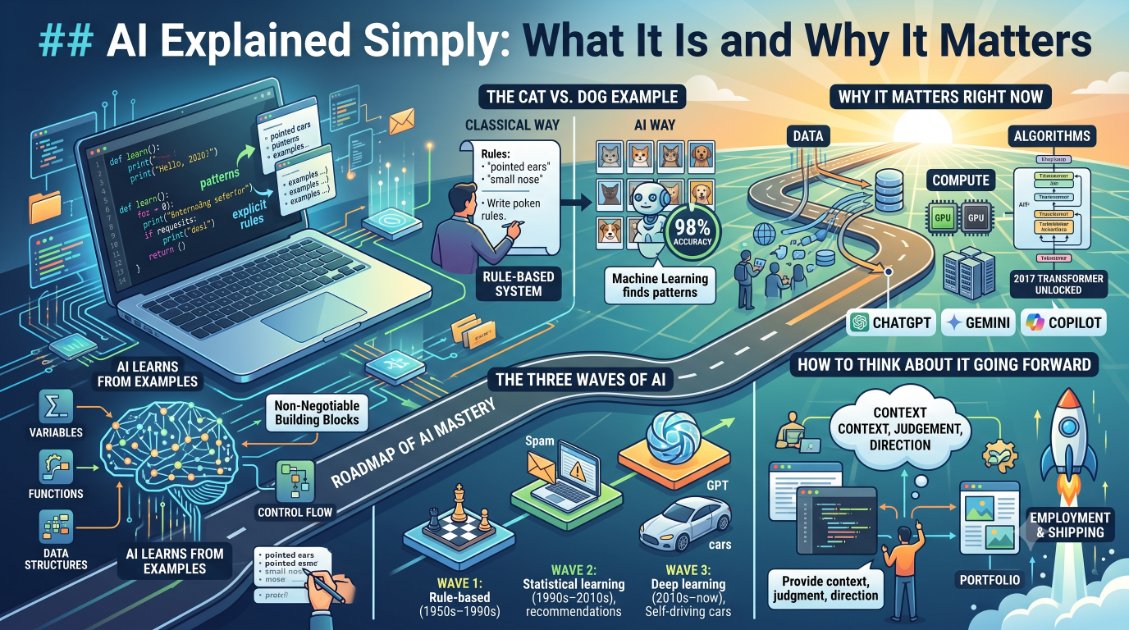
Artificial intelligence sounds intimidating. It doesn't have to be. Here's a plain-English breakdown of what AI actually is, how it works, and why it's reshaping every industry.

AI Explained Simply: What It Is and Why It Matters
You've heard it everywhere — AI is changing everything. But what actually is artificial intelligence? And why should you care?
Let's break it down without the jargon.
What AI Really Means
At its core, artificial intelligence is software that learns from examples instead of following explicit rules.
Traditional software is a set of instructions: if X happens, do Y. A calculator doesn't learn — it just executes rules you wrote. AI is different. Instead of writing rules, you feed it thousands (or millions) of examples, and it figures out the patterns on its own.
That's it. Everything else — machine learning, neural networks, large language models — is a variation of this idea.
A Simple Example
Imagine you want software that can tell a cat apart from a dog in a photo.
The old way: write rules. "If the ears are pointed and the nose is small, it's a cat." This breaks instantly with unusual angles, lighting, or breeds.
The AI way: show the model 100,000 photos labelled "cat" or "dog". The model finds patterns you'd never think to write down — subtle texture differences, proportions, shapes. After training, it gets it right 98% of the time.
That's machine learning in one paragraph.
The Three Waves of AI
Wave 1 — Rule-based systems (1950s–1990s): Experts wrote rules by hand. Chess engines, early medical diagnosis tools. Fast but brittle.
Wave 2 — Statistical learning (1990s–2010s): Let the data speak. Spam filters, recommendation engines, fraud detection. Powerful but needed hand-crafted features.
Wave 3 — Deep learning (2010s–now): Neural networks with millions of parameters that learn features automatically. This is what powers GPT, image generators, voice assistants, and self-driving cars.
Why It Matters Right Now
The reason AI feels like a big deal right now is a convergence of three things that happened simultaneously:
- Data — the internet generated enough labelled data to train useful models
- Compute — GPUs became powerful enough to train large models affordably
- Algorithms — the transformer architecture (2017) unlocked a new level of capability
The result: tools like ChatGPT, Gemini, and Copilot that can write, reason, code, and create — at a level that wasn't possible five years ago.
What AI Is Still Bad At
AI gets a lot right, but it's important to understand its limits:
- It doesn't "understand" — it predicts. A language model doesn't know what it's saying. It predicts the most statistically likely next word. This is why it confidently says wrong things (hallucinations).
- It needs data. AI learns from examples. No data, no intelligence.
- It reflects its training. Biased data produces biased models.
- It can't reason from first principles. It pattern-matches. Novel problems that require genuine reasoning are still hard for AI.
How to Think About It Going Forward
The most useful mental model: AI is a powerful autocomplete for everything.
It autocompletes text (ChatGPT), code (Copilot), images (Midjourney), and decisions (recommendation engines). The autocomplete is surprisingly good — good enough to be genuinely useful in almost every field.
Your job isn't to compete with AI at pattern-matching. It's to provide the context, judgement, and direction that autocomplete can't supply on its own.
The people who understand AI well enough to direct it effectively are the ones who will benefit most from it. That starts with understanding what it actually is — which you now do.
Comments
No comments yet. Be the first to share your thoughts.
Leave a comment
Learn this live, with Prasant
Articles give you a foundation. Live classes give you mastery — where you can ask questions, get real feedback, and build projects.
Browse Courses →